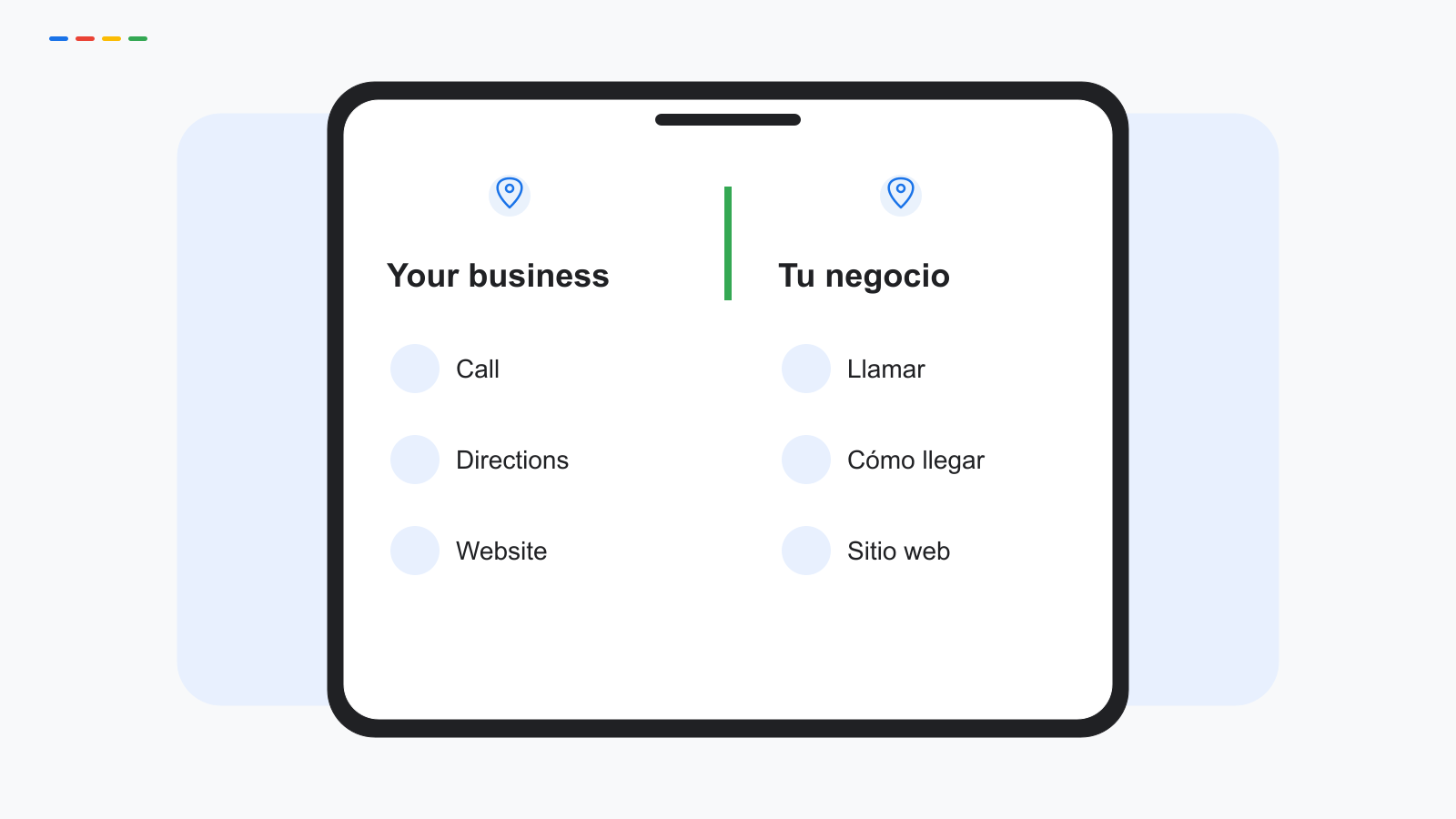
Local SEO for real estate agents works best when the profile identifies a genuine professional and the website offers local knowledge someone can use. Before creating another Google Business Profile, check whether it should represent an agent, team or brokerage. Then build neighborhood pages from information you can verify and maintain. In Miami, English and Spanish communication should carry the same facts about listings, services and the next step.
Start with eligibility and useful content. An agent's name attached to a long list of neighborhoods does not explain what that agent knows or how a prospective customer can reach them.
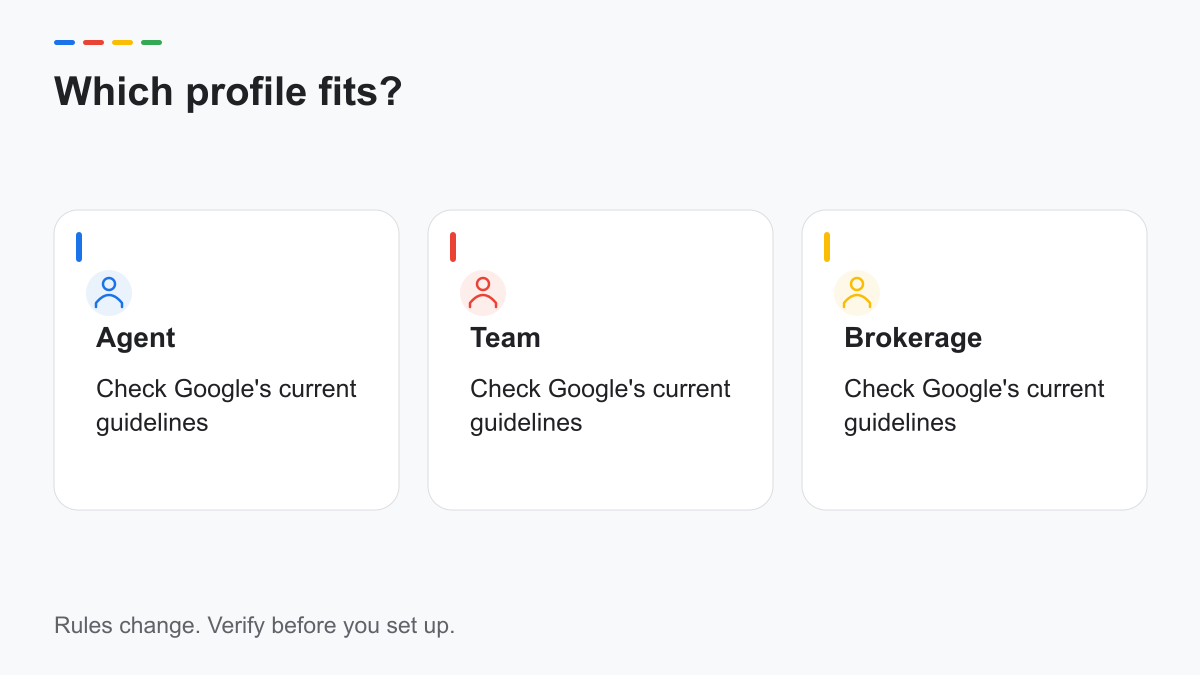
Agent, team or brokerage: which profile is allowed
Google's business guidelines include real estate agents in the individual-practitioner framework. Eligibility depends on the actual public-facing role and direct contact at the verified location; the framework also distinguishes a sole practitioner from several practitioners at an organization.
A team name is not automatic proof of a separately eligible business. Assess what the team represents and how it operates before adding another listing beside agent and brokerage profiles. Read the official guidelines rather than copying a competitor's setup.
Put the existing profiles into a small inventory. Record the identity represented, location, phone, website destination and account owner. Add the brokerage's approved public name and any relevant branding requirements. This gives the broker enough context to review the arrangement without guessing from screenshots.
Do not create profiles for individual properties or neighborhoods as substitutes for a business location. A property page and a business profile perform different jobs. If you work from an arrangement that does not clearly meet Google's rules, pause creation and resolve the eligibility question with official support or qualified advice.
Check what happens when someone calls. A practitioner listing should not send a visitor through a generic route that cannot reach that professional as represented. Likewise, the linked page should identify the agent and explain the relationship with the brokerage accurately.
Use our NAP consistency guide to plan corrections to name, address and phone information. Keep an approval record so an old directory entry does not become the source for another inconsistent profile later.
Neighborhood pages with real local knowledge
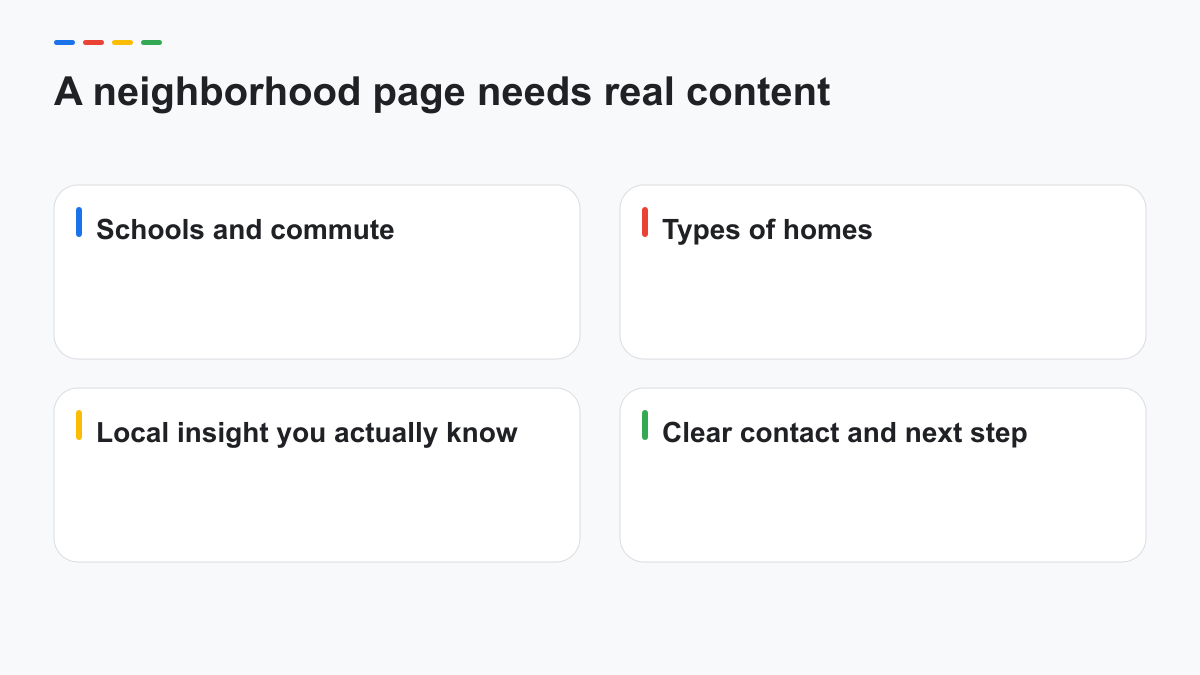
A neighborhood page should help someone frame a decision, not simply repeat that you sell homes there. Describe the questions you can answer from direct experience and identify facts that need an external source. Keep current listing information separate from general neighborhood context.
Example — neighborhood-page content outline:
- Define the area you mean and explain its boundaries.
- Describe the types of homes, with dated sources for quantitative claims.
- Explain commute options and link to official transit information.
- Link to official school information and assignment resources.
- Add local insight you actually know, clearly presented as observation.
- Explain what your service includes and offer a clear contact step.
Schools and commute deserve careful wording. Direct people to the responsible authority for school assignments and current transit information. Do not promise a travel time without context, or present an agent's impression as an official school assessment.
For housing information, say when you checked it. If you use market data, identify the geography, period and source. A price statement without those details becomes difficult to interpret and easy to leave outdated.
Local insight can be specific without pretending to be a statistic. For example, you might explain which questions buyers should ask about a building's parking or association documents. Label such content as a suggested question, rather than claiming that every property shares the same issue.
Write only as many pages as you can support with this level of detail. A single useful page is easier to maintain than a series of cloned city pages. Google's Search spam policies address doorway and scaled-content abuse; page count should follow the content you genuinely have.
Our location-page guide provides a structure for distinct local content: our location-page guide. Adapt the structure to the agent's service area without implying offices in each neighborhood.
Reviews from past clients and how to ask
Build review requests into an approved follow-up process. Invite honest feedback without supplying a rating or a testimonial for the person to paste. Google prohibits incentives and selective solicitation of positive reviews, so avoid a private survey that sends only satisfied people to the public review link.
Example — English request
Thank you for working with our team. If you would like to share your experience, you can leave an honest review here: [review link]. Please avoid including private transaction details.
Example — Spanish request
Gracias por trabajar con nuestro equipo. Si desea compartir su experiencia, puede dejar una reseña sincera aquí: [enlace de reseña]. Por favor, evite incluir detalles privados de la transacción.
These are illustrative drafts. Have the broker review their use and the firm's privacy procedures before adding them to automation. Do not request a review in exchange for a gift, a fee reduction or a preferred service.
Reply to feedback without expanding the public record of a transaction. A reviewer may mention an address, price or personal circumstance; that does not mean you should confirm or elaborate on it. A general acknowledgement and a private contact route are often the more useful response.
When a complaint appears, assign someone to investigate through the approved process. Keep the public reply separate from that investigation. Do not publish internal correspondence to prove a point, and do not claim that a negative review will be removed simply because the team disagrees with it.
Listings, photos and what you may publish
Confirm permission before reusing listing photographs, floor plans or descriptions. Access to an asset through a listing system does not by itself establish unrestricted publication rights. Ask the broker or rights holder to confirm the allowed use and keep that approval with the asset.
Separate active listing content from general service content. A page featuring a property should have someone responsible for updating its status and removing misleading availability claims. A neighborhood guide should not depend entirely on a listing that may disappear.
Use photo captions to describe the actual subject and any relevant date. Do not let an old image imply that a currently unavailable property is ready for a showing. Check whether identifying personal belongings or occupants should be removed before publishing.
If you use staged or generated editorial imagery, disclose its role in the asset record. The hero supplied with this article is an illustrative scene with fictional people; it does not depict a property you represent or prove a customer relationship. It belongs with this educational article, not as documentation of an actual listing.
Keep fair-housing and advertising review within the brokerage's approval process. Avoid unverified neighborhood characterizations such as ideal for a particular kind of household. Describe objective property and location information, and let prospective customers identify their own preferences.
Before publishing a property page, check these details together:
- The listing status and date last reviewed.
- Permission for images and description text.
- Accurate broker and agent identity.
- Contact routing for the represented property.
- Approval of translated wording and required notices.
Bilingual listings and client communication
Use Spanish when the agent or team can support it through the next step. Translate listing facts, contact instructions and service descriptions with the same level of care as the English version. A translated page that changes the meaning of a condition or fee creates a different promise.
Give unfamiliar terms a plain-language explanation instead of relying on a literal translation. Ask a fluent reviewer to compare both versions side by side, including buttons, forms and confirmation messages. Check that phone and booking links lead to the intended professional.
Offer a language choice without assuming it from a surname. If someone asks for a Spanish callback, record that preference through the approved system and route it to someone who can help. Do not describe the whole team as bilingual when availability is limited to a particular person or schedule.
Maintain a correction log for both languages. When the English page changes a listing status or service detail, update its Spanish equivalent before treating the task as complete. Assign one owner for that paired update so neither version becomes an afterthought.
Suggested maintenance routine: check profile identity and contact links, review active listing accuracy, update neighborhood sources that have changed, and inspect the language journey from page to contact. Measure appropriate inquiries with the team's own records; public-profile interactions alone do not establish completed transactions.
For coordinated profile and website help, see our Miami local SEO page.
Frequently asked questions
Can I have my own profile if I work for a brokerage?
An eligible public-facing practitioner can have a profile under Google's practitioner framework. Assess your direct contact, verified location and relationship with the brokerage before creating it.
How many neighborhood pages should I write?
Write as many as you can support with distinct, accurate local information and regular maintenance. There is no universal page count; if the only difference is a place name, reconsider the additional page.
Sources
- Google — Business representation and individual practitioners: support.google.com/business/answer/3038177
- Google — Manage reviews: support.google.com/business/answer/3474050
- Google Maps — Content policy: support.google.com/contributionpolicy/answer/7400114
- Google Search Central — Spam policies: developers.google.com/search/docs/essentials/spam-policies
Sources checked October 12, 2026. Neighborhood data must be sourced for the actual geography before being added.
Want a second look at your profile?
We review public profile structure, contact consistency and the usefulness of the linked page, then respond in one business day. Send only your public Google Maps link; no account access is required. Our bilingual team works remotely and does not promise a ranking or transaction outcome.
Request free audit →